

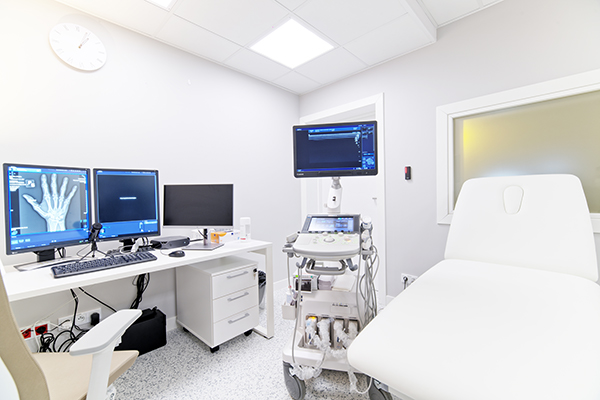
We offer a very wide range of ultrasound examinations, which include orthopaedic and internal ultrasound. The possibility of using various types of ends allows for extensive diagnostics. The camera is equipped with many modern solutions.
Ultrasound diagnostics
Orthopaedic ultrasound diagnostics
Orthopaedic ultrasound, i.e. an ultrasound of the motor organs, allows for a non-invasive determination of diseases and abnormalities in the musculoskeletal system. During the examination, we can assess the soft tissues of the joints, muscles, tendons and nerves in the vicinity of the examined area. It is also possible to dynamically assess the tissues: tendon and muscle movement, joint movement, and ligament stability assessment. The ultrasound examination also allows to visualize the increased vascularization of the diseased tissues – e.g. the inflamed synovial membrane of the joints. Ultrasound examinations in the field of orthopaedics are performed by Beata Ciszkowska-Łysoń, MD, PhD.

In the field of orthopedic ultrasound we perform, among others:
– Ultrasound of the knee joint
– Ultrasound of the hip joint
– Ultrasound of the sacroiliac joints
– Ultrasound of the shoulder joint
– Ultrasound of the elbow joint
– Ultrasound of the hand
– Ultrasound of the ligamentous apparatus of the finger/metacarpus joints
– Ultrasound of sports hernia
– Ultrasound of umbilical hernia
– Ultrasound of peripheral nerves
– Ultrasound of the foot
– Ultrasound of the wrist
– Ultrasound of the ankle joint
– Ultrasound – examination of joint 1 region
– Ultrasound – examination of muscle group 1 region
We invite you!
Internal ultrasound diagnostics
Soft tissue ultrasound examination allows for the assessment of the internal organs, their structure, and size. With high-resolution imaging, we can detect abnormalities and diseases in the body. Such an examination is safe and completely non-invasive. Warning signs of various abnormalities may include pain symptoms (e.g., abdominal pain), detectable changes within a dysfunctional organ, weight loss, diarrhea, vomiting, loss of appetite, etc.
In the field of internal ultrasound we perform, among others:
– Breast ultrasound
– Abdominal ultrasound
– Testicular ultrasound
– Salivary gland ultrasound
– Lymph node ultrasound
– Thyroid ultrasound
– Urinary system ultrasound
– Urinary system ultrasound with prostate gland evaluation
We invite you!
Infant hip ultrasound
Infant hip ultrasound is a procedure aimed at assessing the condition of the hip joints in infants. It is completely painless, non-invasive, and does not require any special preparation. It is one of the fundamental examinations performed in the first few weeks of a child’s life. The ultrasound examination aims to exclude abnormalities in the development of the infant’s hips, including hip dysplasia. Early detection of hip dysplasia allows for complete treatment.
Infant hip ultrasound is performed by:


We invite you!
PREPARATION FOR ULTRASOUND EXAMINATION – PATIENT INFORMATION
In order to ensure your health and safety, please familiarize yourself with the following information regarding imaging and laboratory examinations and adhere to the mentioned guidelines.
GENERAL INFORMATION REGARDING ALL IMAGING EXAMINATIONS
1. It is advisable to arrive approximately 15 minutes before the scheduled appointment to allow time for filling out consent forms and questionnaires prior to the examination.
2. Patients should provide the results of previous diagnostic tests, if available.
3. It is recommended to wear clothing that can be easily removed or rolled up to expose the area of the body being examined.
4. During the examination, it is important to follow all instructions given by the radiologist, technician, or other medical personnel in the facility.
5. Children and adolescents under the age of 18 must be accompanied by a legal guardian or authorized person for diagnostic examinations.
ABDOMINAL ULTRASOUND EXAMINATION
To properly prepare for the appointment, the last meal should be consumed at least 4 hours before the examination.
URINARY BLADDER ULTRASOUND EXAMINATION
Prior to the examination, it is advised not to empty the urinary bladder for an extended period of time.
Please sit calmly for approximately 1 hour. The initial part of the examination will be performed with a full bladder. Subsequently, the doctor will inform you to empty the bladder in order to complete the examination.